VORE
The exhibition of paintings by Kamil Kukla at the Villa Gallery is the first such large-scale display in Łódź of the activities of the artist belonging to the leading Polish painters of the younger generation. The idea of an individual exhibition by the artist at the City Art Gallery in Łódź was born a few years ago when, as a recent graduate of the Academy of Fine Arts in Krakow, he submitted a set of mezzotints for the 15th International Triennale of Small Graphic Forms, Poland – Łódź 2014, and won the Honorary Medal of the event.
For the past few years, Kukla has focused primarily on painting but occasionally reaches for digital tools as well. He also creates objects and experimental music. However, it is painting that best enables the artist to leave his own individual mark in art.
The title of the exhibition – VORE – is the abbreviated name for vorarephilia, which is a kind of paraphilia consisting of deriving sexual pleasure from the fantasy related to devouring, either as a desire to be absorbed by some larger being or to be a passive or active participant in this absorption as a monstrous avatar. In Kukla’s increasingly explicit figurative paintings, this motif seems to be constantly present, returning persistently as an intrusive image. The artist seems to see in this a kind of universal metaphor that goes far beyond “illustrating” a certain dingy phenomenon that can be encountered on the fringes of the Internet. For a long time, Kukla has made no secret of his fascination with digital primarily amateur creativity in the broadest sense of this term, which is far outside the mainstream art world.
He says that what attracts him to the “phenomenon” of vorarephilia is precisely “this taming of a horror which, if realised in the real world, would be an unacceptable nightmare. (…) Suffice it to juxtapose a cartoon character eagerly rushing into the mouth of a carnivorous plant and the photographs of the slit stomachs of boa constrictor snakes, in which the swollen corpse of some poor fellow working in a field somewhere in India is rotting. In the case of the latter, it is like a shock of reality, a confrontation with the embodiment of a fantasy, which in the real world would rather lead to vomiting, remorse, long-term trauma”.
Kukla is fascinated by the phenomenon of vore precisely as a kind of manifestation of the collective subconscious, something that can be generally considered disturbing, sometimes unacceptable in the real world but still constitutes a manifestation of human nature and deeply hidden human desires.
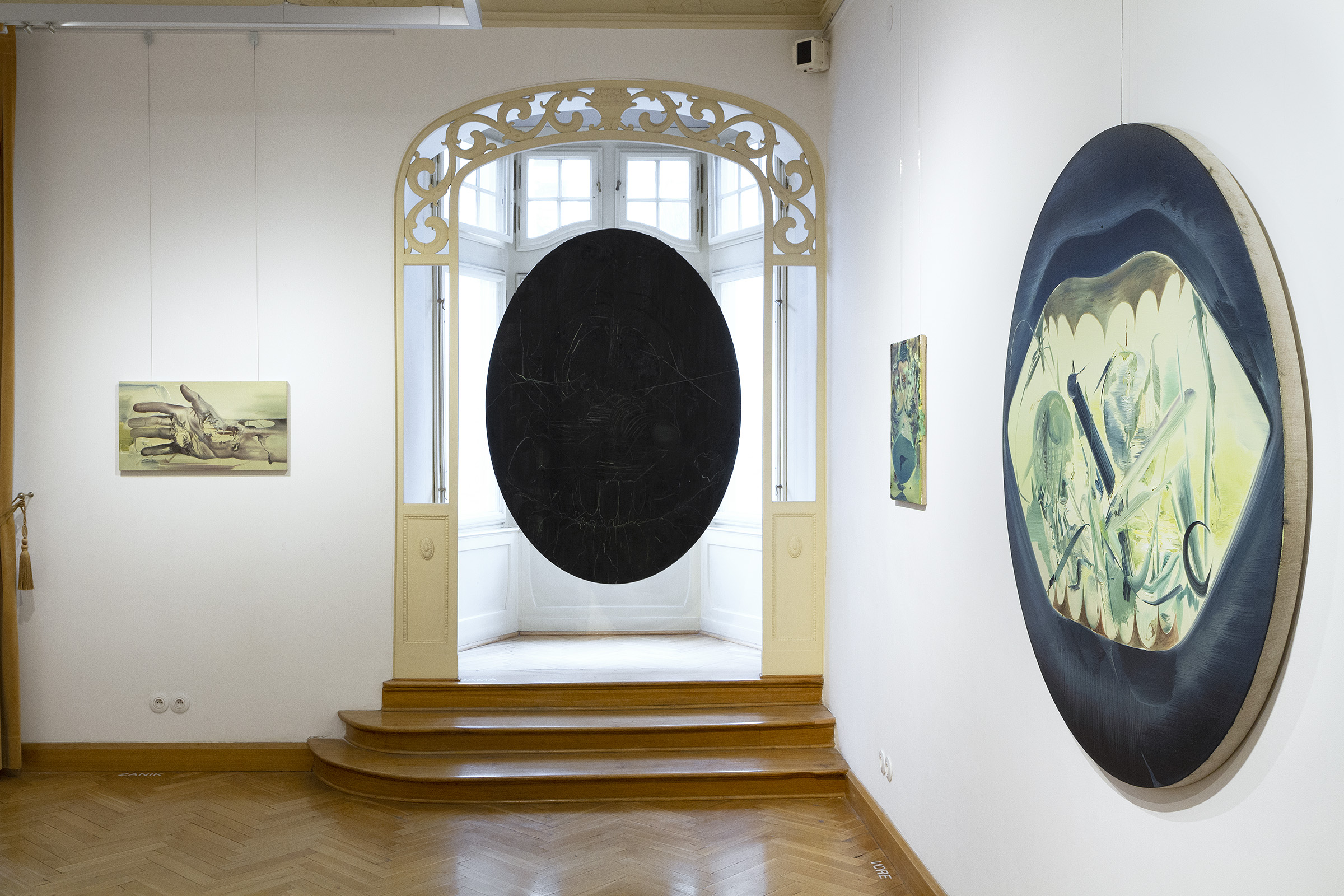
In the artist’s paintings, the motif of vorarephilia is a source of load-bearing visuality that resonates in an evocative way, especially in the present times. Some of the “configurations” associated with this fetish can be read as an expression of toxic masculinity, as a desire for the ultimate enslavement and total control of “weaker subjects”. And from this it is not far at all to the imperial desire to “absorb” the world – or at least part of it. The artist has created several works exploring this theme. One of them shows a close-up of the open maw of a huge monster, devouring, sucking up a part of the body of an unidentified creature.
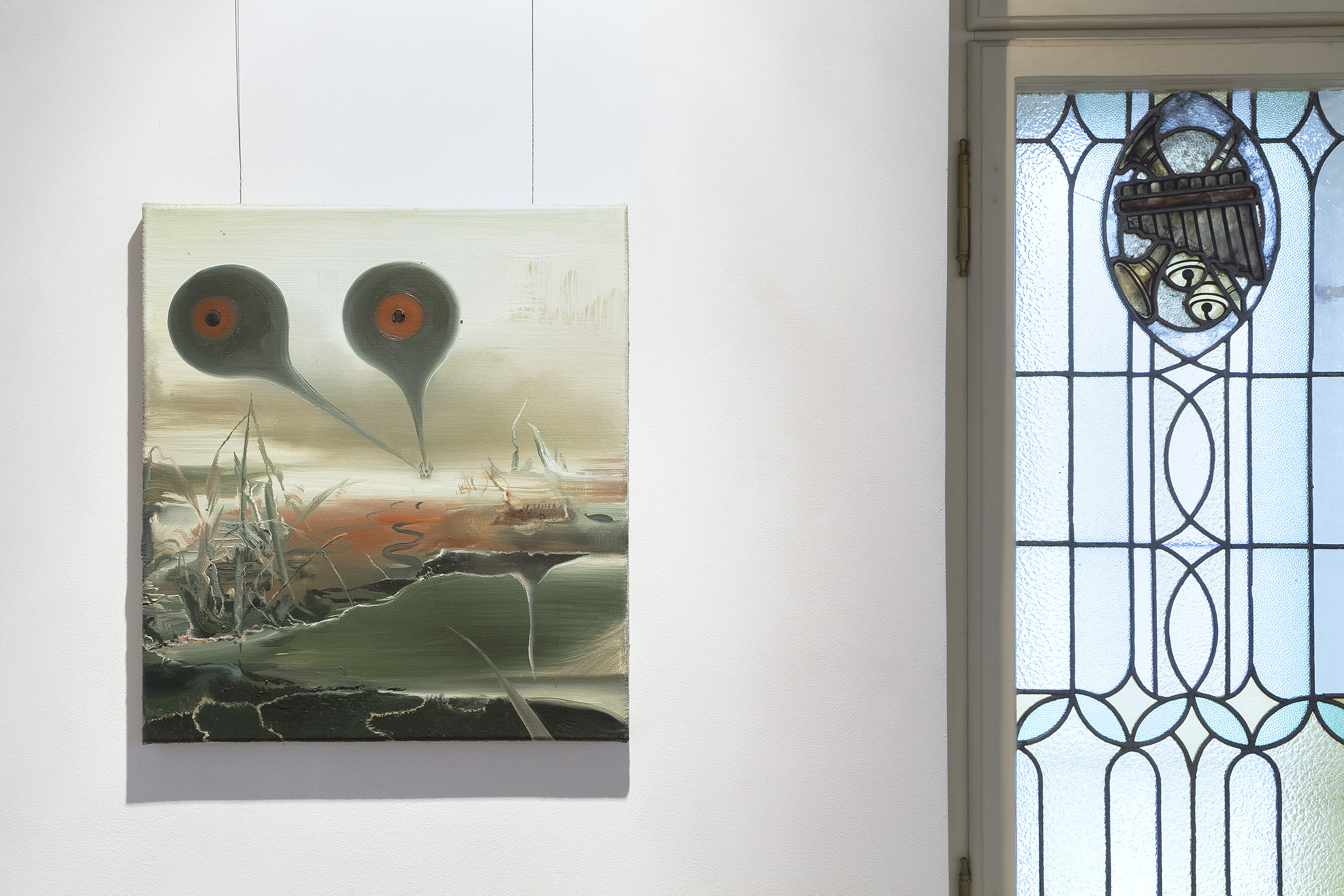
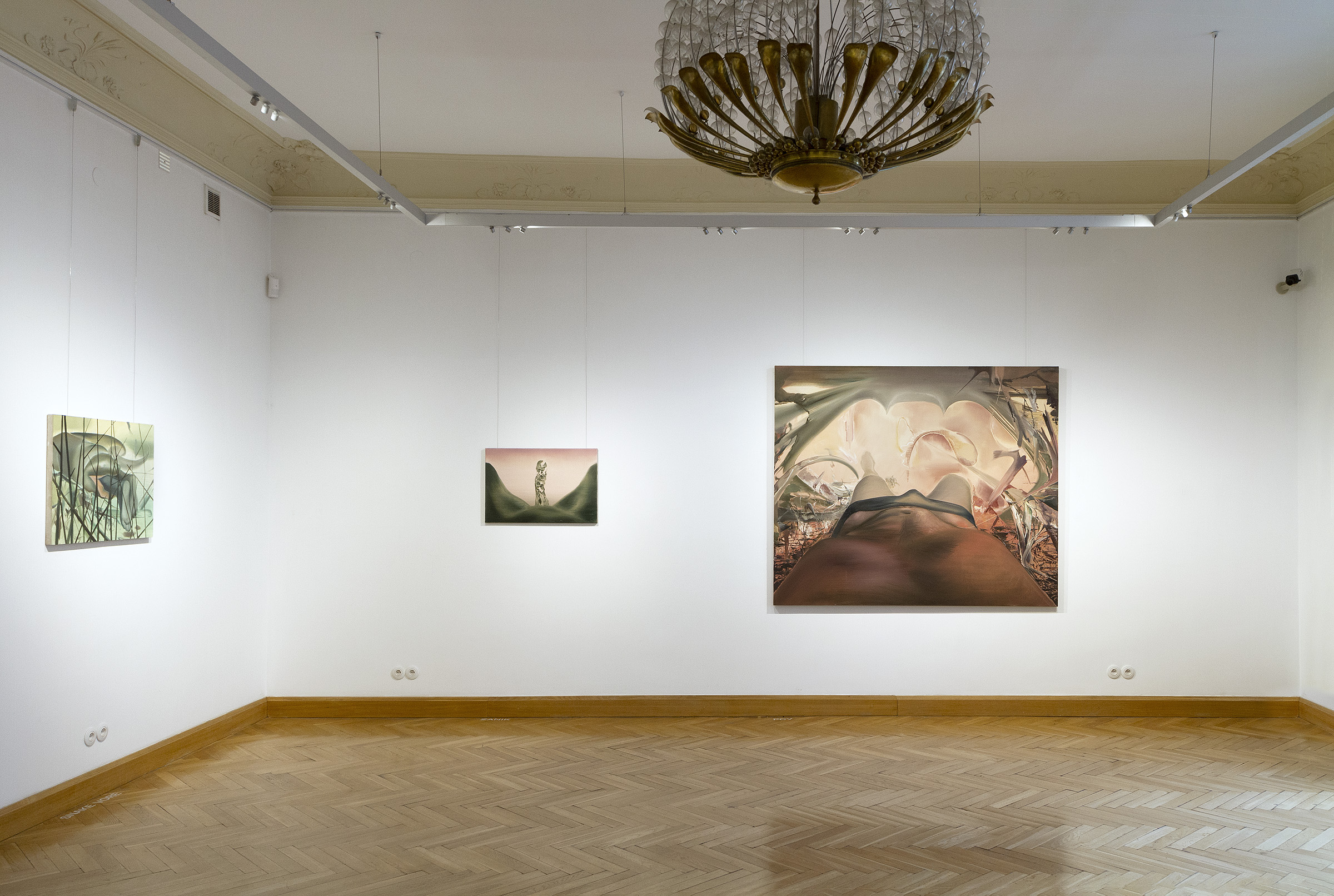
Recently, a certain change and re-evaluation has been taking place in the artist’s work as a painter. Kukla has moved away from “hedonistic debauchery”, luminous pinks, pleasant greens, gentle yellows. Likewise, the eroticism with which his paintings were characterised for a long time is also slowly disappearing. In his own words, “this is due in part to the natural need for change and cyclical pupation. However, the atmosphere of the last two years was not insignificant either. I am by nature a pessimistic person, perhaps already qualifying as a doomer. The present and the oncoming future appear precisely as doom and gloom. The urgent problems of the world are not finding their solutions. On the contrary, they are increasing, inevitably reaching a limit beyond which nothing can be done”. Such a catastrophic landscape, with a fragment of an extinct pond where, in the distance, we can see a human skull, whose only “living” organ is a large monstrous eye piercing near and far, can be seen in the painting titled “DOOM”.
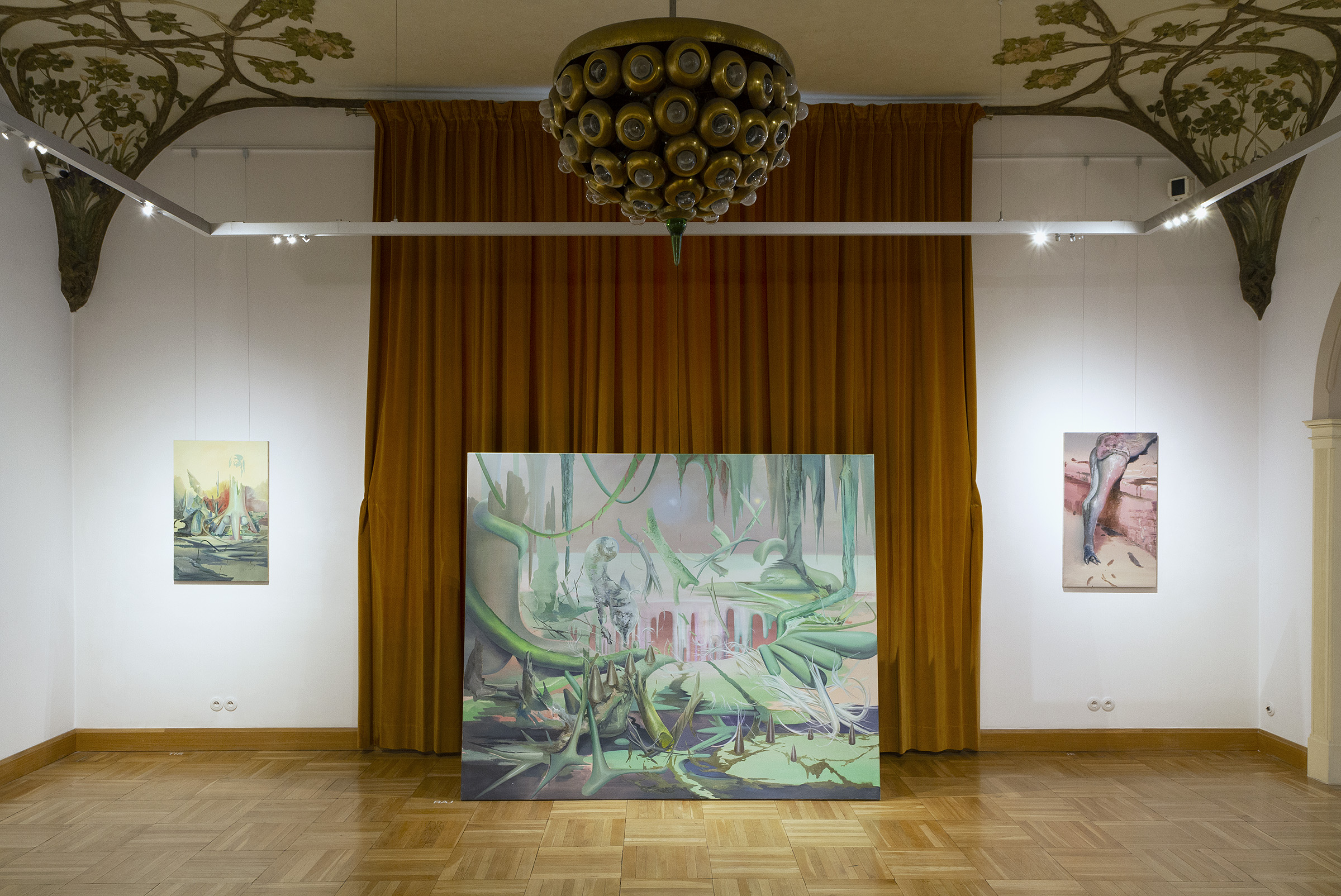
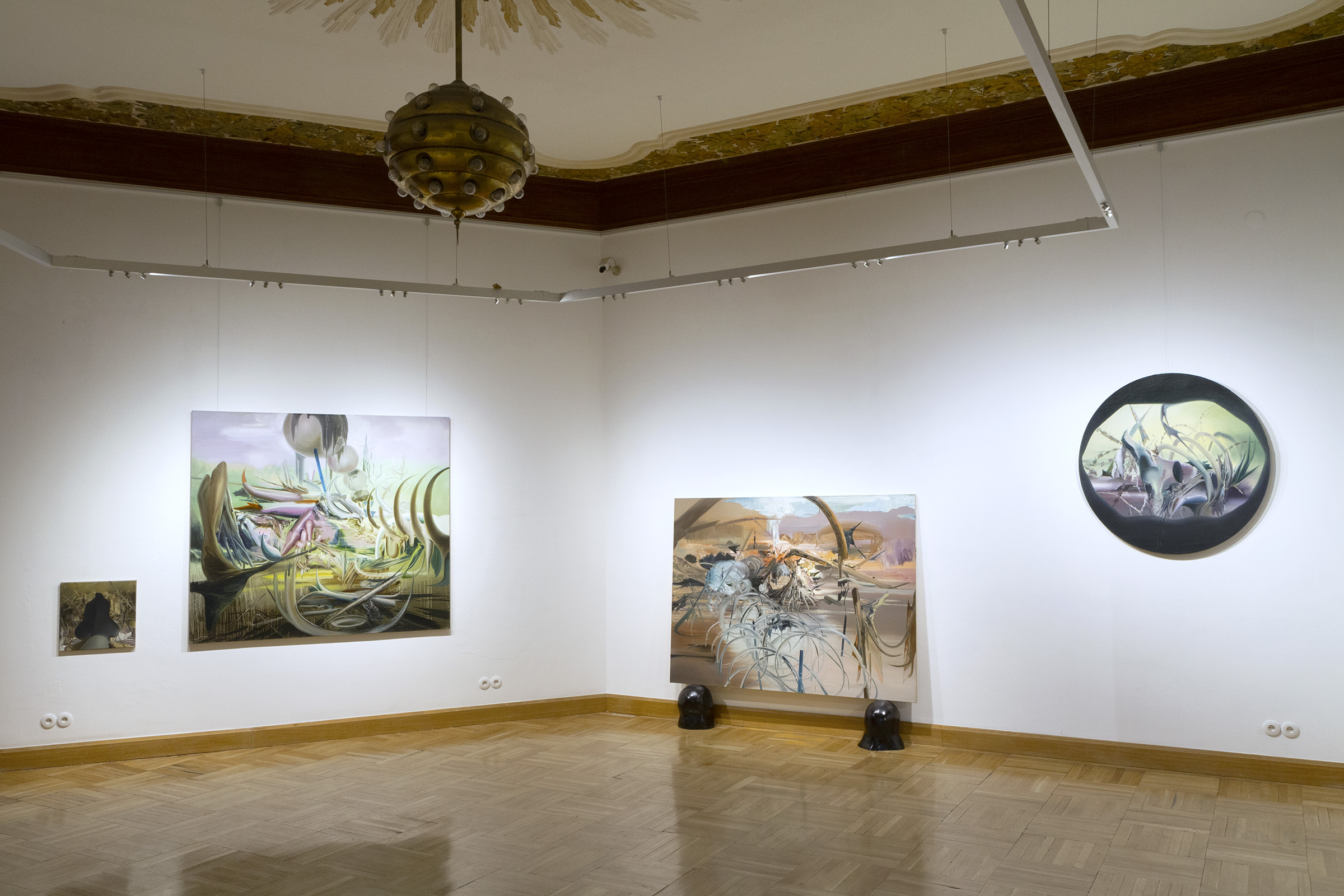
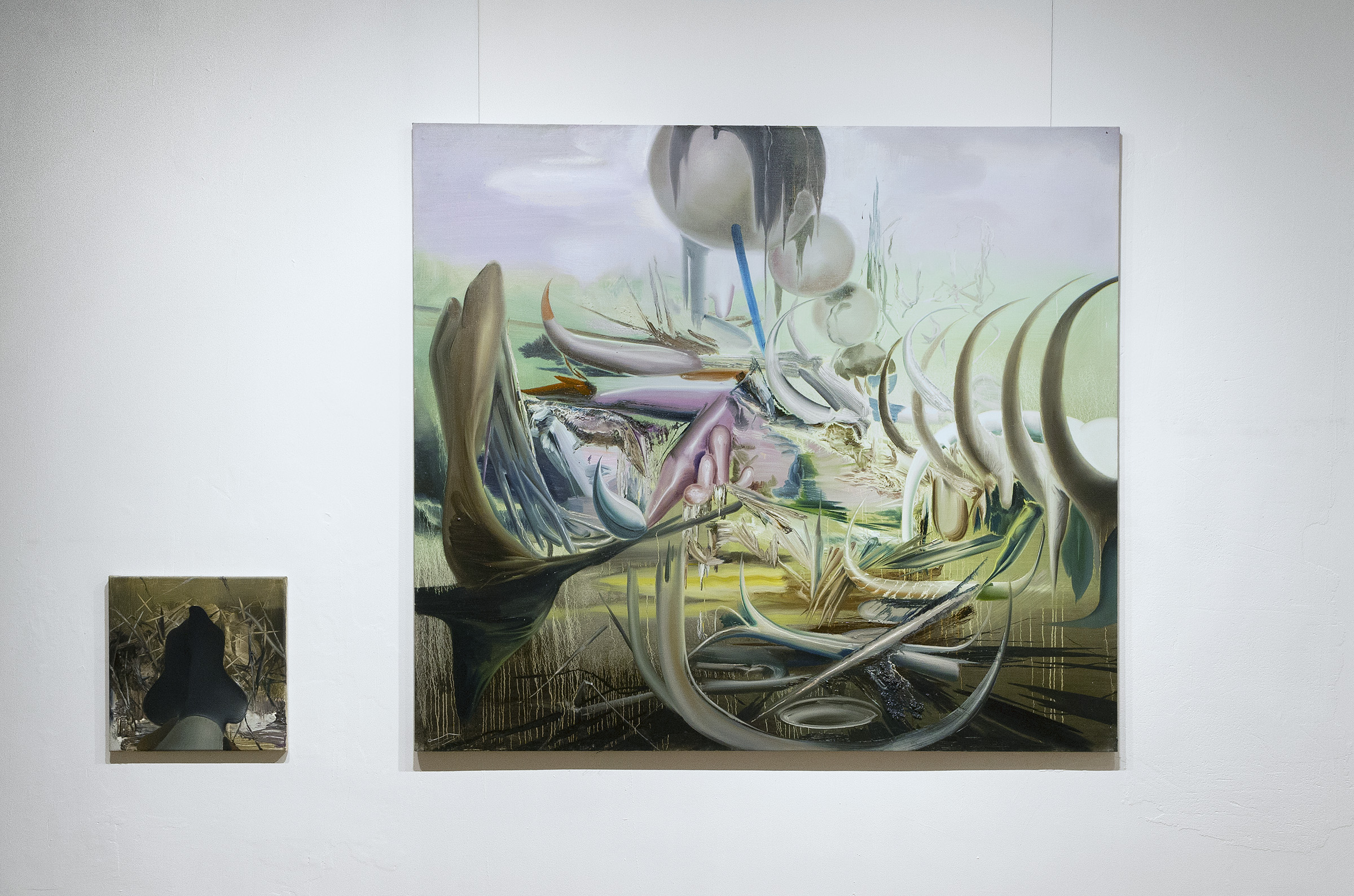
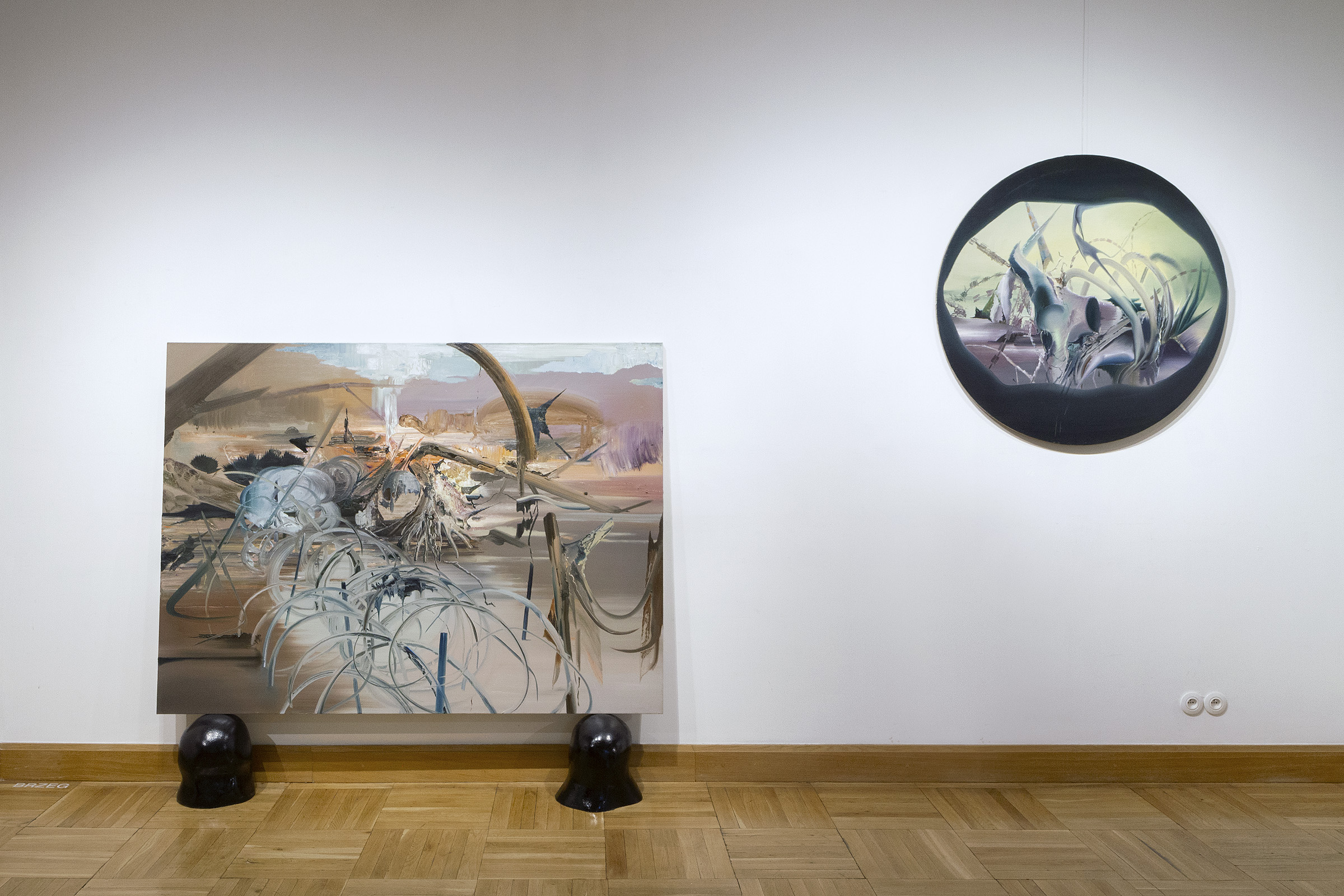
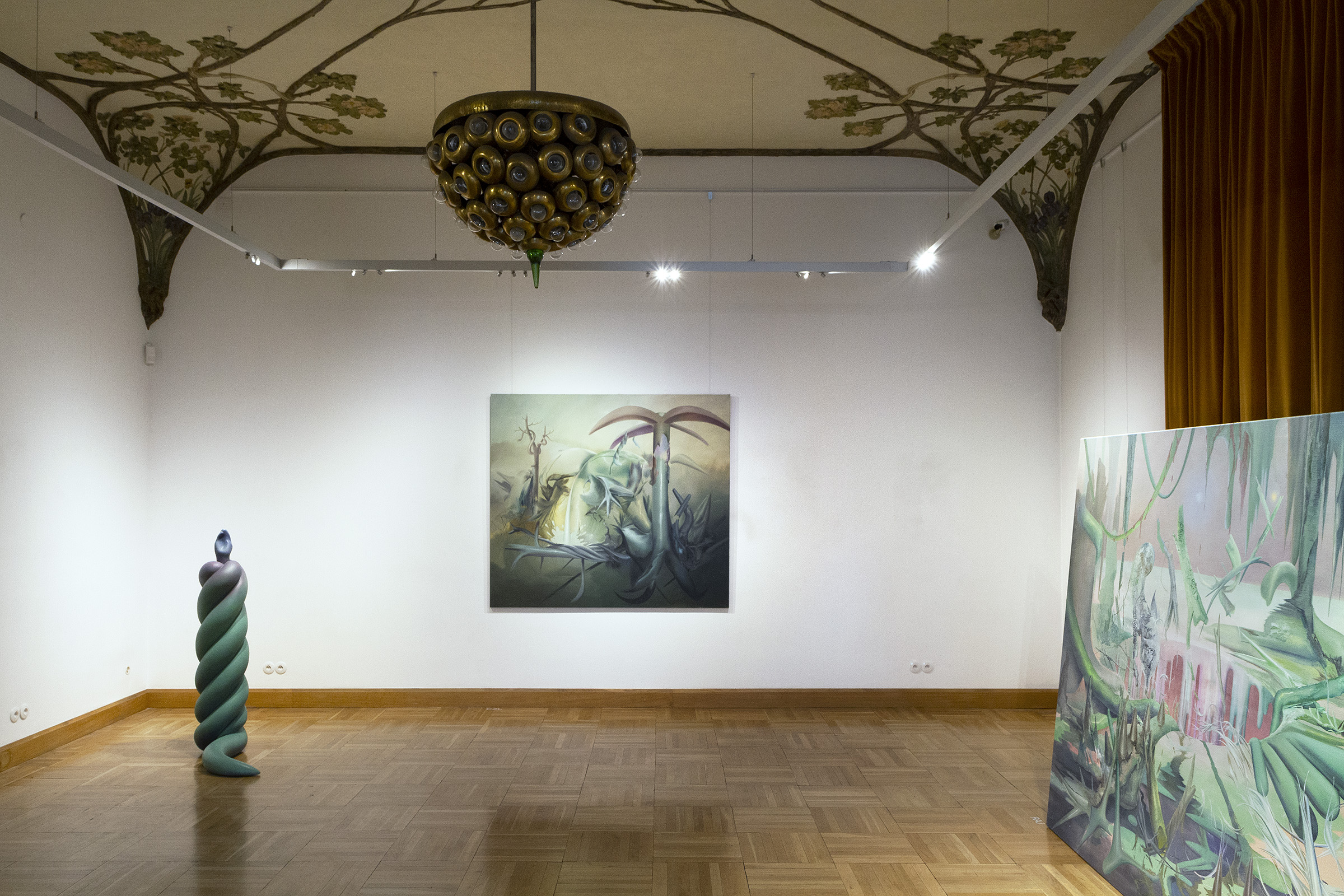
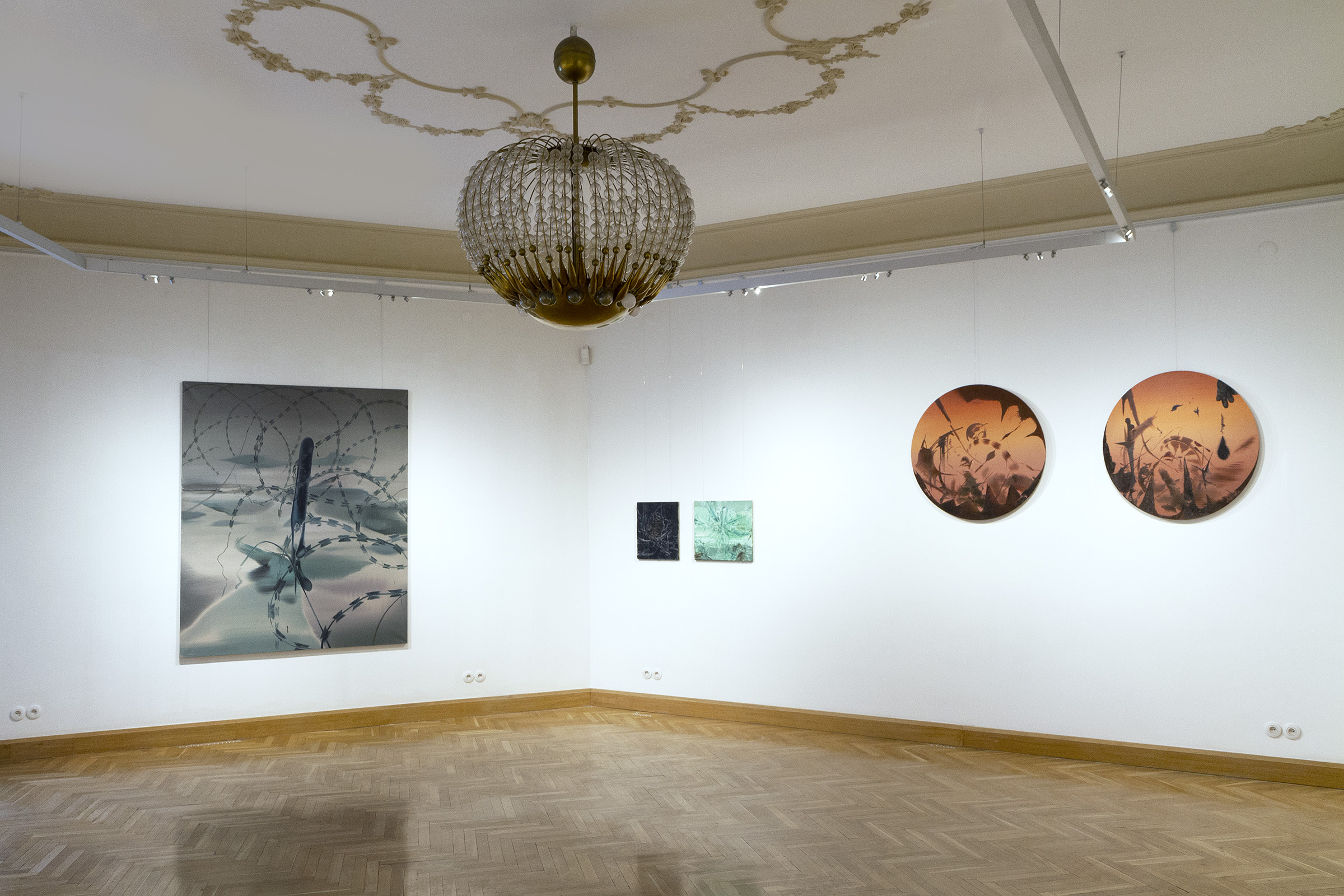
Painted by Kamil Kukla recently, these quasi-landscapes with enigmatic titles are dense with organic, expressive forms alluding to flora and fauna, sometimes also enriched with unreal, fantastic creatures or fragments of the human, often his own, body. On the canvas, the landscape is transformed by the artist into a kind of giant still life, where the richness of the form and the sometimes enigmatic content are developed by means of pain density, sweeping brushstrokes, and sensitive use of a vast range of colours. In the exhibited works from the last two years, the tonality changes to a decidedly darker, more sombre tone than in the earlier more vital and affirmative works resulting from the fascination with exuberant, wanton vitality, and the texture of the paintings is enriched by the shapes engraved with a sharp tool, as in the case of the works: “X”, “MOUTH TO FEED” or the largest, oval “JAMA” [“Burrow”]. The reasons for these changes can be seen in the reaction to events of the outside world. Many of Kamil Kukla’s new works seem to be expressions of the anxieties accumulated over the recent years. He is not indifferent to the stories taking place on the Polish-Belarusian border, the war in Ukraine, the pandemic situation, or the growing ecological crisis. The artist simultaneously smuggles in auto-biographical motifs and a kind of self-observation. Many of the canvases feature limbs – hands, crossed feet or even the entire body – observed either while painting or in a state of “rest”, immobility after the artist has finished his work.
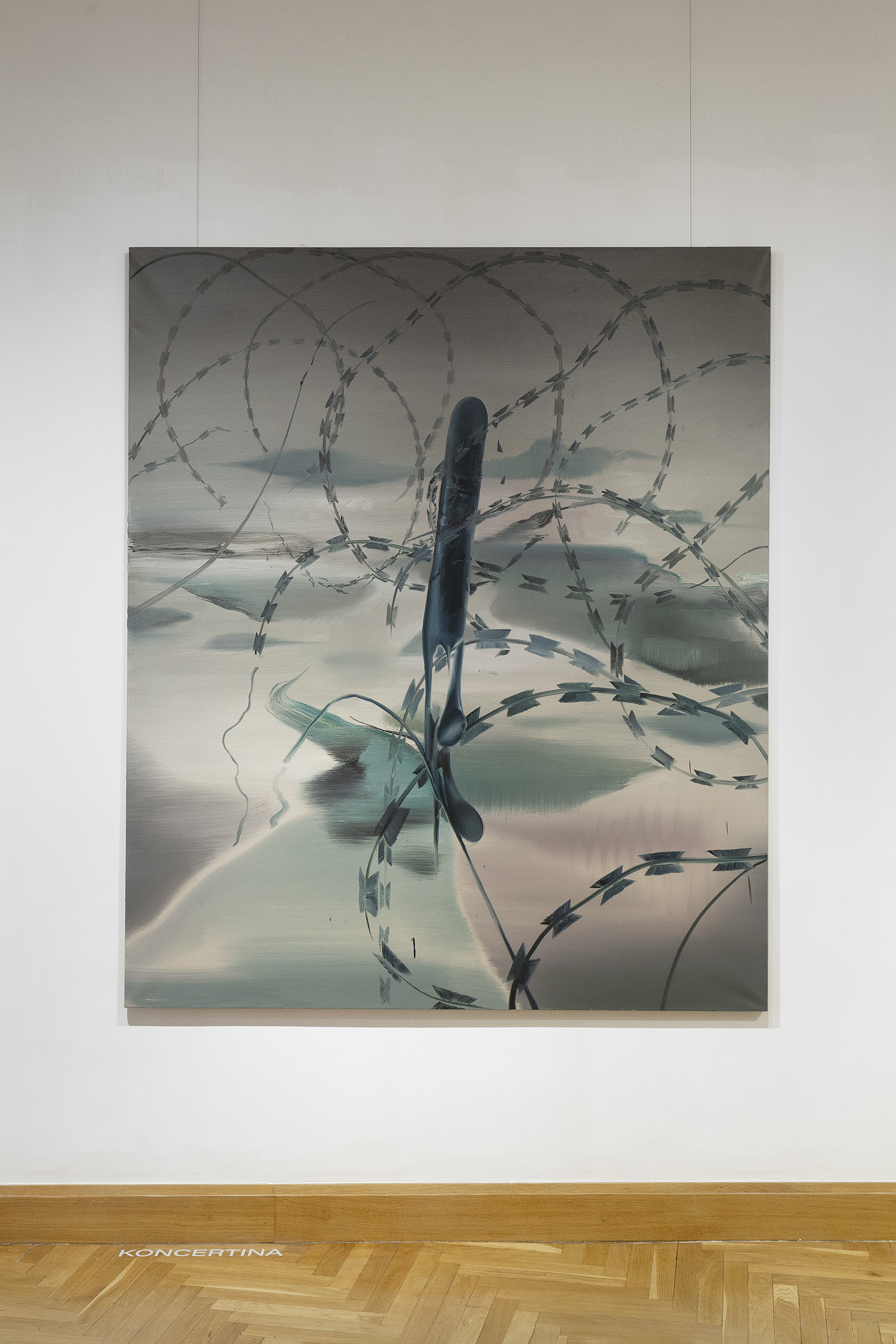
The artist focuses specifically on the humanitarian catastrophe on the border with Belarus, which has been unfolding before our eyes for more than a year. Affected by the events taking place there, he created several paintings under a telling title “KONCERTINA”, or the work “RÓŻOWY” [“Pink’”].
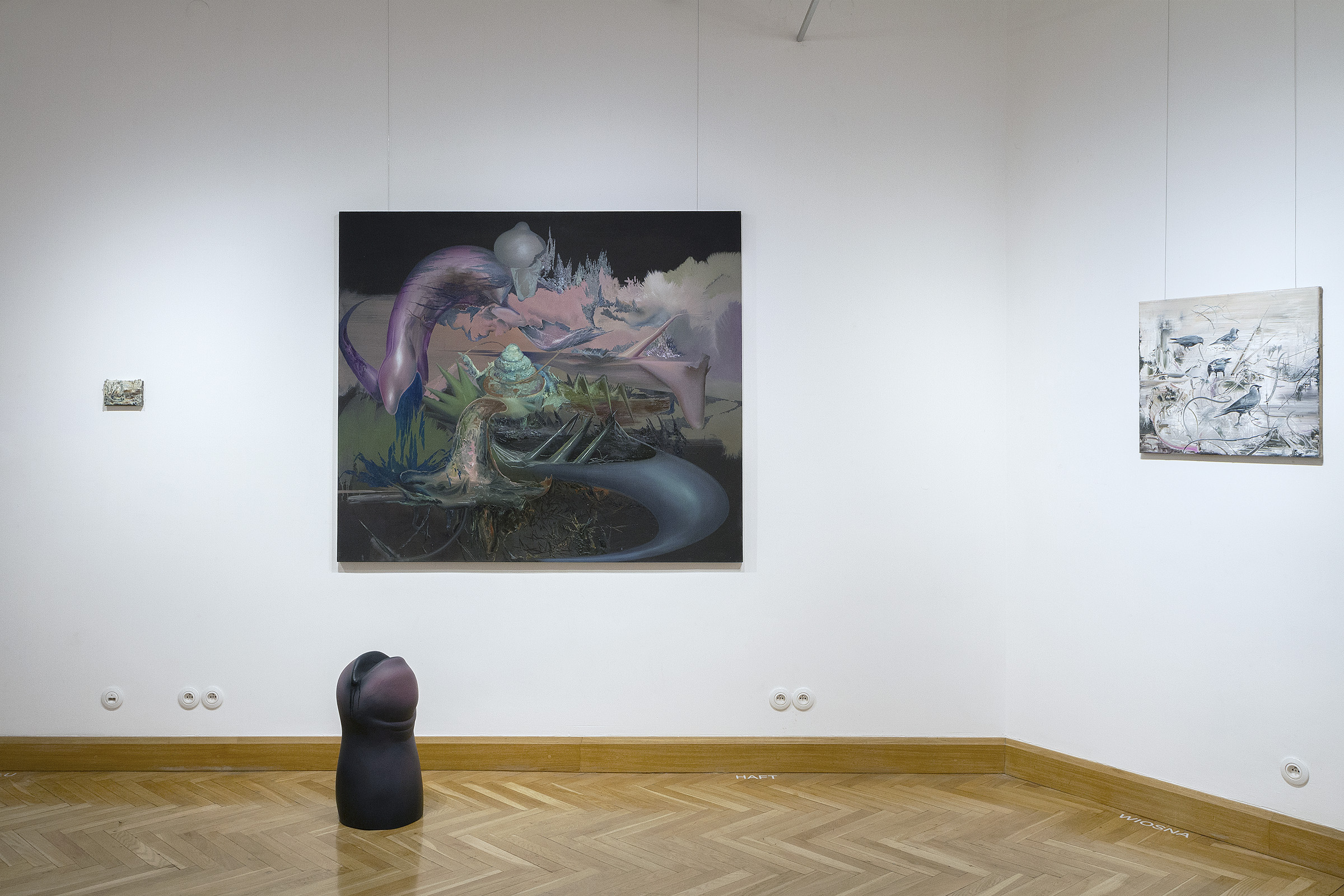
In the works dealing with the theme of ecological cataclysm, he processes, among other things, certain motifs characteristic of the work of the Czech painter and illustrator, Zdenek Burian, author of palaeontological painting reconstructions. Kukla transposes the form of prehistoric reptiles from Burian’s works, creating his own “doom painting, not necessarily in the sense of a Christian Last Judgement but rather ecological annihilation and its inevitable consequences, the great extinction of species”. In the exhibition, this issue is reflected by, among others, the following paintings: “PTAK” [“Bird”] or “WIOSNA” [“Spring”].
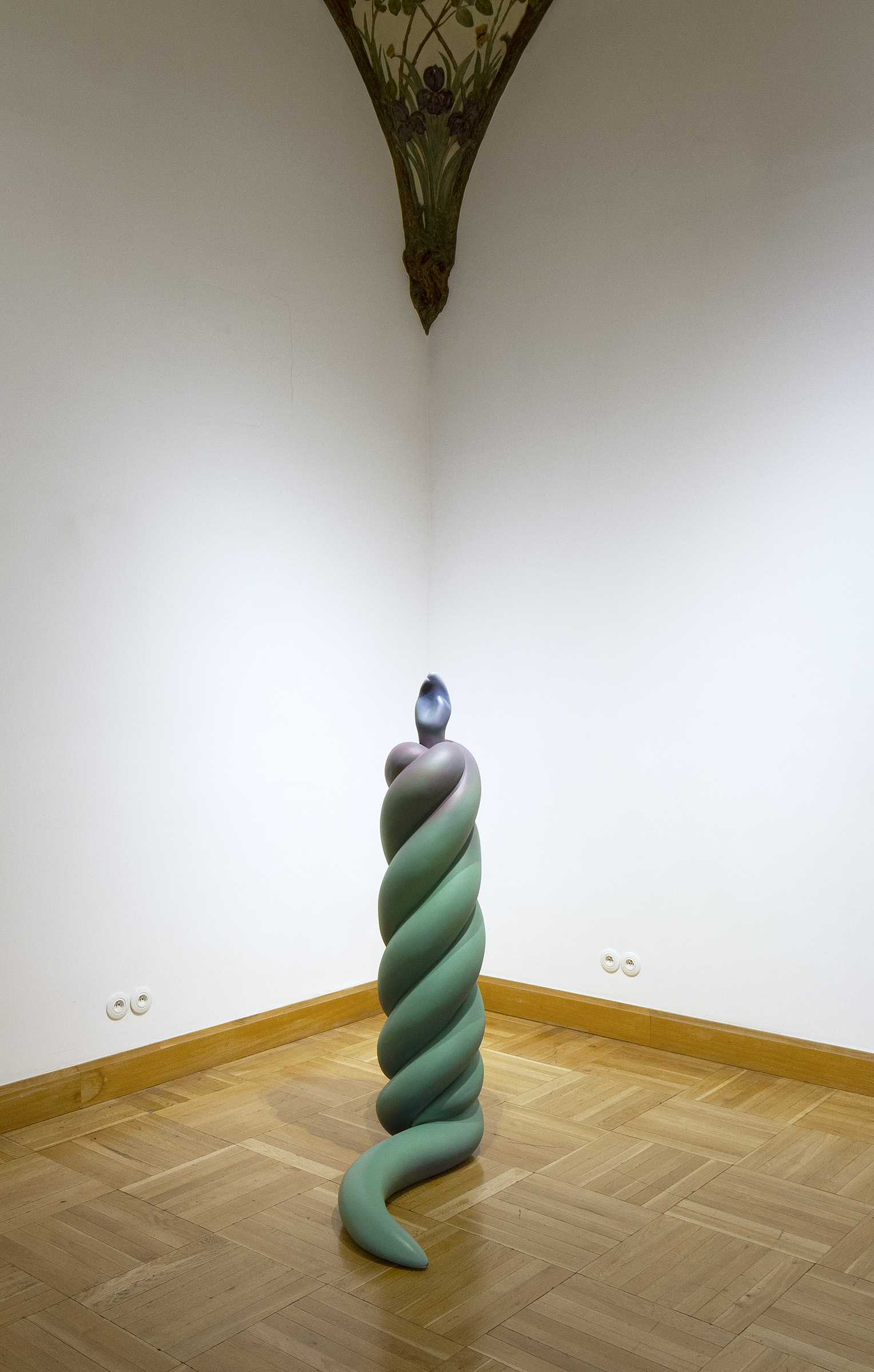
In addition to painting, the gallery space also features three-dimensional forms. They are essential elements of the entire exhibition concept, adding to the stories told directly by the paintings. One of these, located in Mrs Eliza’s former living room, is an object – a green and pink loop, tightening and devouring a human being, of which only a small hand remains “alive”. In the neighbouring room, two black pedestal objects resembling human heads support the painting “BRZEG” [“Shore”], reminiscent of the ruins of an explosion. On the other hand, an integral part of the work “HAFT” [“Vomit”] seems to be an object shaped like a fragment of a snake’s body “taking on” all the “vomit” that comes out of the snake figure – the main character of the painting. The artist emphasises that he often “thinks with objects” when painting. He stresses that “to some extent [painting] has always been a compensation for his inability to sculpt”.
The space of the Villa Gallery, once the property of Leopold Kindermann and his wife Eliza Feder, with its magnificent Art Nouveau floral-animalist ornaments combined with amazing chandeliers designed by Michał Gałkiewicz, the Łódź sculptor and designer among others of lighting forms, has also has its impact on the shape of the exhibition. In a way, Professor Gałkiewicz’s chandeliers stimulated the Krakow artist to create these impressive spatial compositions as Kukla has also been attracted to three-dimensional forms for some time. It turned out that these highly imaginative “sources of light”, testifying to Gałkiewicz’s extraordinary imagination, were in surprising harmony with Kamil Kukla’s paintings. And for the artist, the symbiosis of place – space and the works on display is extremely important, a kind of opus magnum. This can be seen in the work “SKEL”, placed in the former dining room, where grey, levitating circular forms correspond to the form of a chestnut-like source of light hanging in the middle of the room.
Although Kamil Kukla is far from moralising, from wanting to impose a catastrophic interpretation of his recent work, it is impossible not to notice that the whole body of it is an important signal, a warning addressed to his contemporaries of what might happen in the near future. “RAJ” [“Paradise”] painted by Kukla does not resemble the pleasant, even fairy-tale-like, common image of this place of “second” life desired by most people. Rather, it is a vestibule of hell, offering only illusory hope, with a large explosion funnel in the centre, which, sooner or later, if we do not do something positive quickly, will swallow each of us up.
Małgorzata Dzięgielewska
02.12.2022 – 29.01.2023
Curator: Małgorzata Dzięgielewska
Photography: Kamil Kukla